
Why Thousands Who Can't Stop Feeling Dizzy Are Actually Dealing With a Broken Signal From the Top of Their Neck
"I stood up and the room spun… but my inner ear was perfectly normal. Turns out the problem wasn't my ears or my brain — it was a sensory mismatch happening in the joint capsules at the very top of my spine."

If you've ever stood up and felt the room shift — or experienced that
floating, off-balance sensation that makes you grab for the nearest wall —
only to be told "all your tests are normal," you're not alone.
For many people, chronic dizziness doesn't start in the inner ear.
It doesn't start in the brain.
It starts at a hidden sensory crossroads at the very top of your neck.

Right where your skull meets your spine — at C1, C2, and C3 — sits one of
the most densely sensory-rich regions in the human body.
Research published in the NIH confirms that 50% of your body's balance sensors aren't in your inner ear.
They're here, embedded in the joint capsules of your upper cervical spine.
These sensors — called proprioceptors — have one job:
To tell your brain exactly where your head is in space, every single moment.
When they work correctly, you feel:
- Stable
- Grounded
- Clear
But when the deep muscles at the base of your skull become chronically tight —
from years of screen time, poor posture, or accumulated stress — they compress these capsules.
The sensors start firing the wrong coordinates.
And your brain doesn't ignore the conflict.
It activates a full-body alarm response — the same response it uses when you're about to fall.
That's why you feel:
- Lightheaded when standing up
- Eyes unable to track movement cleanly
- Like the ground is slightly unstable even when you're still
A landmark study of 1,000 chronic dizziness patients found that 90% of cases — after ruling out inner ear and cardiac causes — traced back to the cervical spine.
(Takahashi S. — Journal of Rural Medicine, PMC, 2018)
This isn't anxiety.
This isn't aging.
This is a sensor problem.
And it starts in your neck.
🔹 WHAT YOUR DOCTOR MIGHT BE MISSING
THE CERVICAL PROPRIOCEPTOR PROBLEM
Standard balance tests measure the vestibular system — your inner ear.
Most scans evaluate the brain.
Almost none evaluate the proprioceptive capsules at C1, C2, and C3 —
the actual location where 50% of your balance sensors live.
This region plays a critical role in:
• Precise head-neck position sensing
• Communication with the vestibular nucleus in the brainstem
• Coordinating eye movement with head movement
• Postural stability and spatial orientation
It's also where the deep suboccipital muscles — the most sensor-dense muscles in the human body — tend to stiffen with age, stress, and prolonged screen use.

When these muscles stay compressed, they:
• Distort the position signal sent to your brain
• Create a sensory mismatch between neck and vestibular input
• Trigger a constant low-level alarm state in the nervous system
That's why so many people experience:
• Dizziness that vestibular exercises don't fully resolve
• Visual disturbances when moving the head
• Unsteadiness worse at the end of the day
• "Anxiety" that actually tracks with neck tension
It's not in your head.
Your GPS is broken.
And the GPS lives in your neck.
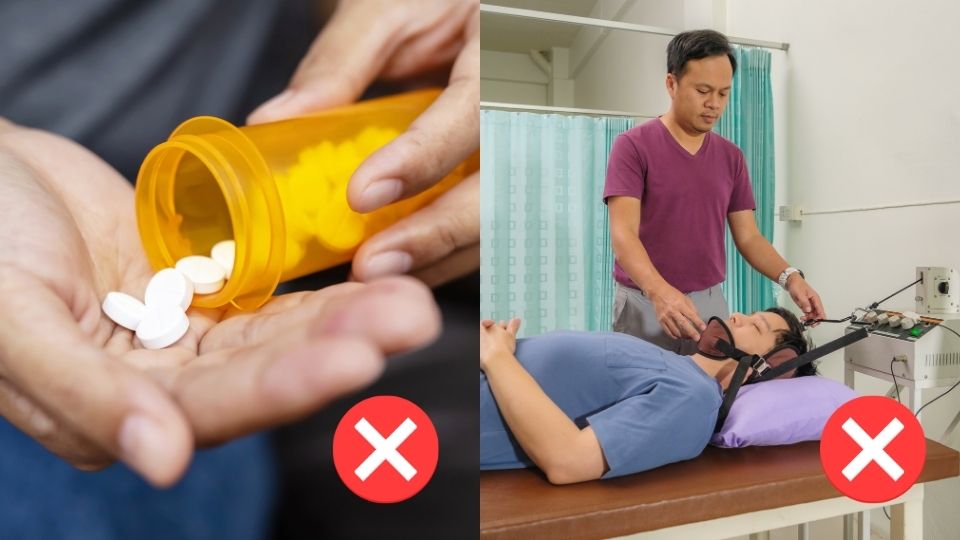
🔹 WHY PILLS, MASSAGE & STRETCHING NEVER FULLY FIX IT
Anti-vertigo medication, vestibular rehabilitation exercises, and even
careful stretching can help temporarily.
But they all share one limitation:
They don't restore the accuracy of the proprioceptive signal coming from your upper cervical joint capsules.
So the cycle continues:
Medication → dizziness eases briefly
Balance exercises → stability improves for a day
Daily posture returns → sensors compress again
→ Signal distorts again
→ Dizziness returns
You're training the vestibular system to compensate for a broken signal — not fixing the signal itself.
To create lasting change, you need to:
• Release compression from the C1-C3 joint capsules
• Restore blood flow and oxygen to the proprioceptive tissue
• Re-engage the deep neck stabilizers
That's exactly what HealthEase was designed to support.

🔹 AT-HOME CHECK
Ever notice any of these?
• Standing up makes the room briefly spin or shift
• Turning your head too fast causes lightheadedness
• Your eyes feel like they lag behind your head movement
• You feel "floaty" or unsteady even when standing still
• Brain fog that gets worse when you're tired or stressed
• Headaches that start at the base of the skull
• Ear fullness or ringing without any ear infection
These are common signs that your upper cervical proprioceptors may be sending incorrect signals to your brain's balance center.
Left unaddressed, this pattern tends to progress:
• Occasional lightheadedness becomes daily unsteadiness
• Visual disturbances become more frequent
• Brain fog deepens and fatigue sets in
• Fear of standing up, turning your head, or busy environments
That's why we created a way to support this region safely at home,
in just minutes a day.
Meet HealthEase
NeuroCervical™ Core Therapy
A 4-in-1 At-Home Device Designed to Support Upper Cervical Proprioceptive Recovery & Balance System Reset
Most neck devices offer surface-level comfort.
HealthEase is different.
It was designed to target the craniocervical junction — specifically the C1-C3 region where your balance sensors live.
Instead of treating dizziness symptoms, HealthEase focuses on the proprioceptive source where the broken signal originates.
Here's what it combines
Patented 26-Degree Cervical Traction
Decompresses the C1-C3 joint capsules at the precise 26-degree angle
that creates space around the proprioceptive tissue.
Not a generic stretch — the exact geometry that targets your balance sensors.
EMS (Electro Muscular Stimulation)
Sends small electrical pulses into deep suboccipital muscles, forcing
rhythmic contraction and release.
Acts like a pump pushing oxygen-rich blood into the capsules where the sensors live.
More oxygen → more accurate sensor signals.
Targeted Massage Heads
Press directly into the tight suboccipital muscles at the base of the skull.
Releases the mechanical compression distorting your proprioceptive signal.
Therapeutic Heat
Dilates blood vessels in the upper cervical region, increasing circulation
to compressed joint capsule tissue.
Helps reduce inflammation and restore proprioceptive accuracy.
This isn't just comfort.
It's a targeted approach to fixing the broken signal at its source.
Just lie back, let the device cradle your upper neck,
choose your settings — and let HealthEase do the work.
No appointments.
No drugs.
No cracking.

How HealthEase Works (Step by Step)
Step 1 – Decompress the C1-C3 Joint Capsules
The 26-degree traction system gently creates space around the upper cervical joints — where your proprioceptive sensors are compressed.
Step 2 – Restore Blood Flow with EMS
Low-frequency EMS pulses cause rhythmic muscle contraction, acting like a pump driving oxygen-rich blood into the sensor capsules.
Step 3 – Release Compression with Targeted Massage
Floating massage nodes work directly into suboccipital trigger points — releasing the tension compressing your balance sensors.
Step 4 – Reduce Inflammation with Therapeutic Heat
Gentle warmth increases circulation and reduces inflammation around the upper cervical region.
Many users describe feeling grounded and stable — even after the first session.
10 minutes a day is often enough to start recalibrating the signal.

What People Commonly Notice Over the First Few Weeks
While everyone is different, many users describe a similar progression:
Day 1
Neck muscles feel less tight at the base of the skull.
Some users notice reduced dizziness the same day.
Week 1
• Fewer head rush moments
• No longer grabbing the wall when standing
• Sleep improves
Week 2
• Eyes track head movement more smoothly
• Floating sensation reduces significantly
• Clearer thinking
Week 4 and Beyond
Balance sensors recalibrate and dizziness becomes rare and mild.
Over 31,000 people worldwide now use HealthEase daily.

Picture Standing Up… and the Room Stays Still
Imagine this:
You stand up from the couch and…
Nothing happens.
No spinning.
No sudden rush.
No grabbing the wall.
You turn your head quickly and your vision stays clear.
You walk through a crowded store without that floating feeling.
You wake up in the morning feeling oriented.
That's what life can feel like when the broken signal from your neck is corrected — not just compensated for.

What’s the Price of HealthEase?
When you consider:
• Repeated ENT and neurologist visits
• Endless anti-vertigo prescriptions
• Time lost to dizziness and instability
You'd expect a 4-in-1 clinical-grade cervical support device like HealthEase to be expensive.
But for a limited time, you can get up to 53% off the regular price.
That means:
Daily cervical traction, EMS, targeted massage and heat
For less than the cost of a single specialist visit.
One device.
One-time investment.
Daily support for your balance system.
👉 Click below to check availability and apply your discount.
Try HealthEase for 365 Days, Completely Risk-Free
HealthEase comes with a 365-day results guarantee.
Use it consistently to:
• Decompress the C1-C3 capsules
• Restore oxygen to proprioceptive tissue
• Retrain deep neck stabilizers
If you don't feel a meaningful change in balance and steadiness…
Send it back for a full refund.
No stress.
No questions.
No risk.
UPDATE: Selling Out Fast Due to Viral Demand
Since HealthEase started gaining traction on social media,
inventory has been selling out quickly.
With the limited-time 53% discount, demand is even higher.
We still have a few units left — but they may sell out soon.
Don't miss out.
Click below to secure your discount and check availability now.
What Are People Saying About HealthEase?

Reviewed in the United States on May 05, 2024
Verified Purchase
I was bounced between cardiology, ENT, and gastro for years. Palpitations, reflux, dizziness — every test came back 'normal.' I honestly thought I was losing my mind. After learning about the vagus nerve and trying HealthEase, things finally clicked. Within the first week the spinning when I stood up started to calm down. By week three, my reflux and chest rushes were way less frequent. I still use it most evenings because it's the only thing that makes my neck and nervous system feel truly quiet.

76 people found this helpful

Reviewed in the United States on May 25, 2024
Verified Purchase
I've got a long history of neck issues and two herniated discs, but the worst part was the vertigo. I'd stand up and feel like the floor tilted. My doctor said it was 'just anxiety.' HealthEase was the first thing that actually addressed the base of my skull. The combination of traction, EMS and heat makes that area feel open and light. I still get the occasional off day, but it's nothing like before. I can work, drive, and play with my kids without constantly worrying the room will start spinning.

53 people found this helpful

Kate Michaels
Reviewed in the United States on May 25, 2024
Verified Purchase
I bought HealthEase for neck pain from working at a desk, but the surprise benefit was my digestion and throat. I used to feel like food was 'stuck' and I was always clearing my throat. A few weeks into using this, that tight, choking feeling almost disappeared. My neck feels longer and looser, and I notice I'm not reaching for antacids like before. It's become part of my night routine — 15 minutes on the couch before bed and my whole upper body feels calmer.

64 people found this helpful