
Why Thousands With an Unexplained Racing Heart Are Actually Dealing With a Nerve Signal Problem in Their Neck — Not Their Heart
"I wore a Holter monitor for two weeks. ECG was perfect. Cardiologist said I was fine. But my heart kept racing at rest, and I couldn't sleep without it pounding. Turns out the nerve clusters controlling my heart rate sit right next to C2, C3, and C4 — and mine were being compressed."

If you've had your heart thoroughly checked — ECG, Holter monitor, echocardiogram — been told everything is normal, but your heart still races, flutters, or skips beats for no clear reason — you're not alone.
For many people, an unexplained racing heart doesn't start in the heart.
It starts at a nerve crossroads just a few centimeters below your skull.

Running directly alongside your cervical vertebrae — right next to C2, C3, and C4 — are clusters of nerve tissue called the cervical sympathetic ganglia.
These are the nerve hubs that send the electrical signals governing your heart rate. Not suggestions. Direct signals. Your heart's rhythm is being regulated, in part, from your neck.
Think of these ganglia like a thermostat for your heart. When they're calm and uncompressed, your heart stays regulated — steady, quiet, unhurried.
But when the suboccipital muscles at the base of your skull become chronically tight, they create mechanical pressure along the front of the cervical spine — directly against these ganglia. The thermostat gets stuck on high.
Your heart receives continuous "speed up" signals it was never designed to receive around the clock.
A population study of over 22,000 patients confirmed this connection:
people with cervical spine degeneration have a 3.1x higher risk of cardiac arrhythmia — specifically because of this cervical sympathetic ganglion pathway.
(PMC6162845 — Journal of Clinical Medicine, 2018 — n=22,236)
This isn't anxiety.
This isn't a cardiac condition.
This is a mechanical nerve problem. And it starts in your neck.
🔹 WHAT YOUR DOCTOR MIGHT BE MISSING
THE CERVICAL SYMPATHETIC GANGLION PROBLEM
Cardiologists test the heart. Thoroughly and well.
What almost no one tests is the cervical sympathetic chain — the nerve pathway running directly alongside C2, C3, and C4, whose job is to regulate your heart rate from above.
This region plays a critical role in:
• Governing the heart's electrical rhythm via direct nerve signaling
• Regulating the balance between sympathetic (accelerate) and parasympathetic (calm) cardiac control
• Maintaining normal resting heart rate and rhythm stability
It's also exactly where the deep cervical muscles — when chronically tight from stress, posture, or screen time — create sustained mechanical pressure.

When this pressure builds and stays, it:
• Continuously irritates the sympathetic ganglia
• Keeps the cardiac "thermostat" stuck in an elevated state
• Drives a persistent sympathetic overdrive — fast, reactive, restless
That's why so many people experience:
• Palpitations that no cardiac test can explain
• Anxiety that feels physical and unresponsive to therapy
• Racing heart at rest with no identifiable trigger
• Insomnia driven by heart awareness, not racing thoughts
It's not a heart problem.
The thermostat is stuck.
And the thermostat lives in your neck.
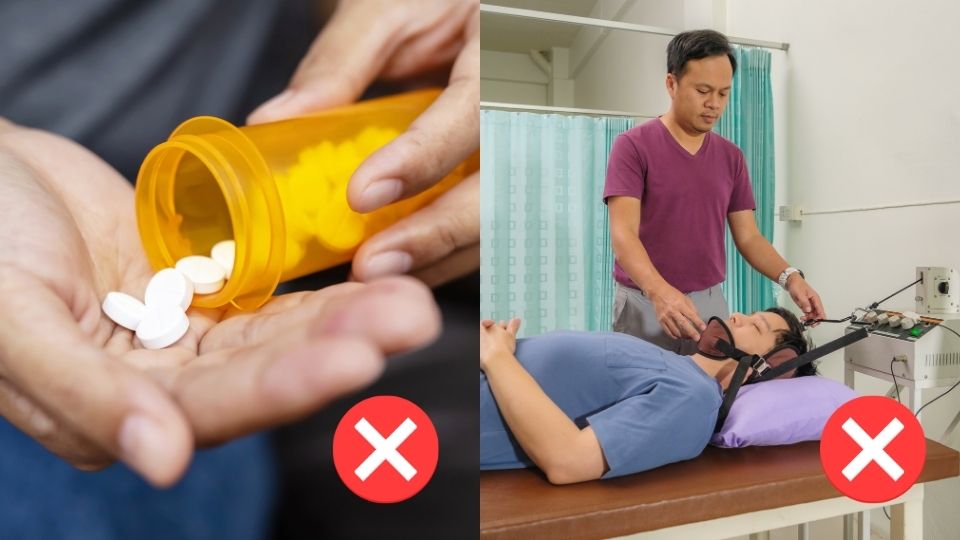
🔹 WHY PILLS, BETA-BLOCKERS & ANXIETY MEDICATION NEVER FULLY FIX IT
Beta-blockers, anti-anxiety medication, and even relaxation techniques can reduce the sensation temporarily.
But they all share the same limitation:
They don't release the mechanical pressure on the cervical sympathetic ganglia that's keeping the thermostat elevated.
So the cycle continues:
You take medication → heart rate slows briefly
You practice breathing → palpitations ease for an hour
You return to daily posture and stress → compression returns
→ ganglia stay irritated → thermostat stays stuck on high
You're dampening the signal — not removing the source of the irritation.
To create lasting change, you need to:
• Release the mechanical pressure on the cervical sympathetic chain
• Allow the ganglia to decompress and return to normal threshold
• Re-engage the deep neck stabilizers so the pressure doesn't rebuild
That's exactly what HealthEase was designed to support.

🔹 AT-HOME CHECK
Ever notice any of these?
• Heart races or flutters when you're completely at rest
• Palpitations that worsen when your neck is stiff or tense
• Lying down triggers more noticeable heart awareness
• Chest tightness that no cardiac test can explain
• Sleep disrupted by awareness of your own heartbeat
• Daytime anxiety that feels physical, not emotional
• Neck stiffness that tends to worsen on the same days as palpitations
These are common signs that mechanical pressure on the cervical sympathetic ganglia may be keeping your heart rate thermostat stuck on high.
Left unaddressed, this pattern tends to escalate:
• Occasional flutter becomes daily palpitation episodes
• Sleep disruption deepens as the nervous system never switches off
• Daytime anxiety compounds — the body stays in a low-level alert state
• Secondary symptoms appear: fatigue, chest tightness, breath awareness
That's why we created a way to support this region safely at home, in just minutes a day.
Meet HealthEase
NeuroCervical™ Core Therapy
A 4-in-1 At-Home Device Designed to Support Cervical Sympathetic
Decompression & Cardiac Autonomic Rebalancing
Most neck devices offer surface-level muscle relief.
HealthEase is different.
It was designed to target the cervical sympathetic pathway — specifically the C2-C4 region where the nerve clusters governing your heart rate sit — using four clinically-informed mechanisms that work simultaneously.
Instead of managing palpitation symptoms, HealthEase focuses on the mechanical source of the sympathetic overdrive.
Here's what it combines:
Patented 26-Degree Cervical Traction
Creates physical decompression along the anterior cervical spine — the exact space where the sympathetic chain runs.
At 26 degrees, the traction geometry specifically opens the C2-C4 zone, creating separation between the tight muscles and the ganglia they're pressing against.
EMS (Electro Muscular Stimulation)
Sends electrical pulses into the cervical muscles adjacent to the sympathetic chain, forcing rhythmic contraction and release.
This breaks the sustained static compression on the ganglia.
As the muscles cycle through release, the mechanical irritation begins to quiet — and the "speed up" signal to the heart begins to normalize.
Targeted Massage Heads
Work into the posterior cervical muscles, releasing the layered tension that transmits mechanical load forward onto the sympathetic structures.
When the posterior tension releases, the anterior pressure on the ganglion chain drops.
The thermostat begins to reset.
Therapeutic Heat
Increases circulation to the compressed nerve tissue.
Reduces local inflammation around the ganglia, removes the metabolic waste that sustains nerve irritation, and delivers the oxygen needed for the tissue to recover its normal signaling threshold.
This isn't just relaxation.
It's a targeted approach to releasing the mechanical pressure that's keeping your heart rate elevated — starting at the structural source.
Just lie back, let the device cradle your upper neck, choose your settings — and let HealthEase do the work.
No appointments.
No drugs.
No cracking.

How HealthEase Works (Step by Step)
Step 1 – Decompress the Cervical Sympathetic Pathway
The 26-degree traction system creates physical space along the front of the cervical spine at C2-C4 — directly decompressing the nerve clusters that govern your heart rate.
As the ganglia decompress, the sustained irritation begins to ease.
Step 2 – Break the Compression Cycle with EMS
Low-frequency EMS pulses force the deep cervical muscles into rhythmic contraction and release — interrupting the sustained static tension pressing against the sympathetic chain.
With each contraction-release cycle, the mechanical grip on the ganglia loosens further.
Step 3 – Release the Posterior Tension with Targeted Massage
Floating massage nodes work into the posterior cervical muscles — releasing the layered tension that transmits compressive load forward onto the sympathetic structures.
As the posterior chain releases, the anterior pressure drops and the cardiac thermostat begins to lower.
Step 4 – Calm the Nerve Tissue with Therapeutic Heat
Gentle, targeted warmth dilates blood vessels around the C2-C4 region, reducing the inflammation that sustains sympathetic irritation.
Many users describe a deep physical calm settling in — not just in the neck, but through the chest — as the nervous system finally begins to shift from sympathetic to parasympathetic dominance.
10 minutes a day is often enough to start resetting the thermostat.

What People Commonly Notice Over the First Few Weeks
While everyone is different, many users describe a similar progression:
By Day 1
Neck and shoulder area noticeably releases after the first session.
Some users report the chest feeling less tight and resting heart rate feeling calmer by the first evening.
By Week 1
Palpitation episodes become less frequent.
Sleep begins to improve — no more lying awake with heart awareness.
Morning anxiety reduces as the nervous system begins to rebalance.
By Week 2
Resting heart rate stabilizes noticeably.
Sudden "racing for no reason" episodes become less frequent and less intense.
Users report the nervous system finally begins to "switch off" in the evenings.
By Week 4 and Beyond
The sympathetic ganglia have decompressed enough for the heart to self-regulate near normally.
Users describe:
"For the first time in years, I stopped being aware of my own heartbeat — because it was finally beating normally."
Over 31,000 people worldwide now use HealthEase daily as their go-to at-home cervical nerve decompression routine.

Picture Your Heart Finally Going Quiet.
Imagine this:
You sit down after work and… nothing.
No flutter in your chest.
No sudden awareness of your heartbeat.
No lying awake wondering if something is wrong with you.
You make it through a meeting without watching your pulse on your watch.
You fall asleep without that low hum of cardiac awareness keeping you just alert enough to not fully rest.
You wake up and your body feels like it actually recovered — because it finally could.
That's what life can start to feel like when the mechanical pressure on the nerve clusters governing your heart rate is finally released — instead of endlessly managed with medication.

What’s the Price of HealthEase?
When you consider:
The cost of repeated cardiologist visits, Holter monitors, and follow-ups
Ongoing beta-blocker or anxiety medication prescriptions
Nights lost to heart awareness and disrupted sleep
You'd expect a 4-in-1, clinical-grade cervical nerve decompression device like HealthEase to be expensive.
But for a limited time, you can get HealthEase for up to 53% off the regular price.
That means:
Daily cervical traction, EMS, targeted massage and heat
For less than the cost of one cardiologist visit.
One device.
One-time investment.
Daily support for the nerve pathway your heart rhythm depends on.
Stocks are limited — once this batch sells out, this discount ends.
👉 Click below to check availability and apply your discount.
Try HealthEase for 365 Days, Completely Risk-Free
We know it can feel defeating to try something new — especially when you've already had your heart cleared multiple times and still live with unexplained palpitations.
That's why HealthEase comes with a 365-day results guarantee.
Use it consistently. Let it:
• Decompress the cervical sympathetic ganglia at C2-C4
• Release the mechanical pressure keeping the cardiac thermostat elevated
• Retrain your deep neck stabilizers so the pressure doesn't rebuild
If you don't feel a meaningful change in your heart rhythm, resting heart rate, and sense of calm…
send it back for a full refund.
No stress.
No questions.
No risk.
It's essentially a 365-day at-home trial to see what happens when you finally release the nerve pressure — not just manage the signal it's creating.
UPDATE: Selling Out Fast Due to Viral Demand
Since HealthEase started gaining traction on social media, we've had a hard time keeping it on the shelves.
And now with our limited-time 53% discount, demand is through the roof.
We still have a few units left — but at this pace, we expect to sell out soon.
Don't miss out — click below to secure your discount and check availability now.
What Are People Saying About HealthEase?

Reviewed in the United States on May 05, 2024
Verified Purchase
I was bounced between cardiology, ENT, and gastro for years. Palpitations, reflux, dizziness — every test came back 'normal.' I honestly thought I was losing my mind. After learning about the vagus nerve and trying HealthEase, things finally clicked. Within the first week the spinning when I stood up started to calm down. By week three, my reflux and chest rushes were way less frequent. I still use it most evenings because it's the only thing that makes my neck and nervous system feel truly quiet.

76 people found this helpful

Reviewed in the United States on May 25, 2024
Verified Purchase
I've got a long history of neck issues and two herniated discs, but the worst part was the vertigo. I'd stand up and feel like the floor tilted. My doctor said it was 'just anxiety.' HealthEase was the first thing that actually addressed the base of my skull. The combination of traction, EMS and heat makes that area feel open and light. I still get the occasional off day, but it's nothing like before. I can work, drive, and play with my kids without constantly worrying the room will start spinning.

53 people found this helpful

Kate Michaels
Reviewed in the United States on May 25, 2024
Verified Purchase
I bought HealthEase for neck pain from working at a desk, but the surprise benefit was my digestion and throat. I used to feel like food was 'stuck' and I was always clearing my throat. A few weeks into using this, that tight, choking feeling almost disappeared. My neck feels longer and looser, and I notice I'm not reaching for antacids like before. It's become part of my night routine — 15 minutes on the couch before bed and my whole upper body feels calmer.

64 people found this helpful