
Why Thousands With Unexplained Fatigue, Dizziness, Reflux & Heart Flutters Are Actually Dealing With One Structural Problem — Not Four Separate Ones
"GP said normal. Cardiologist said normal. Neurologist said normal. Gastroenterologist said normal. Four specialists, four 'normal' results, and I still couldn't explain why I felt exhausted, dizzy, reflux-y, and like my heart was never quite calm — all at the same time. Turns out they were all looking at different branches of the same tree. Nobody looked at the trunk."

If you've seen multiple doctors for multiple symptoms — dizziness, heart palpitations, reflux, chronic fatigue, tension headaches — and been told each one is either normal, stress-related, or requires its own separate medication, you're not alone.
For many people, these symptoms aren't four separate problems.
They're four outputs of a single structural source — a mechanical overload happening in the upper cervical spine that affects all of them simultaneously.

Your head weighs approximately 10 to 12 pounds. When it sits directly over your spine, your neck muscles carry that load with minimal effort.
But for every inch your head moves forward — looking at a phone, working at a desk, reading — the effective load your neck must manage nearly doubles.
Most people today are walking around with their head 2 to 3 inches forward of where it should be. That means the deep muscles at the base of the skull are managing 2 to 3 times their designed load — every hour, every day.
(Hansraj KK — Surgical Technology International, 2014: at just 15 degrees of forward tilt, effective head load increases from 10-12 lbs to 27 lbs)
Think of the suboccipital muscles like an overloaded circuit breaker panel. Your balance sensors, heart rate regulators, and digestive nerve pathways all run through the same panel.
When the panel is overloaded, circuits start tripping.
Not one at a time. All of them, slowly, in sequence.
Here's what that overload actually does: the deep suboccipital muscles — which contain the highest concentration of sensory receptors in the entire human body — become chronically compressed.
They press against three different neural structures simultaneously:
• The proprioceptive joint capsules at C1-C3 (balance sensors)
• The cervical sympathetic ganglia at C2-C4 (heart rate regulation)
• The vagal nerve pathway at C1-C2 (digestive system control)
One set of overloaded muscles. Three systems breaking down at once.
This has documented clinical evidence:
A 35-year-old woman developed GERD directly from poor cervical posture during remote work. After cervical correction — GERD resolved completely. No dietary changes. No medication.
(PMC8161447 — Journal of Chiropractic Medicine, 2021)
A study of 22,236 patients confirmed that people with cervical spine degeneration have a 3.1x higher risk of cardiac arrhythmia — because the cervical sympathetic ganglia sit directly adjacent to C2-C4.
(PMC6162845 — Journal of Clinical Medicine, 2018)
A study of 1,000 chronic dizziness patients found that 90% of cases — after ruling out all other causes — traced back to the cervical spine.
(Takahashi S. — Journal of Rural Medicine, PMC, 2018)
Three separate studies.
Three different symptoms.
One structural source.
🔹 WHAT YOUR DOCTOR MIGHT BE MISSING
THE UPPER CROSS SYNDROME COMPRESSION PROBLEM
Each specialist is looking at one branch of the tree.
Cardiologist → tests the heart
Gastroenterologist → tests the stomach and esophagus
ENT → tests the inner ear
Neurologist → tests the brain
What almost no one assesses is the upper cervical spine — specifically whether the suboccipital muscles are overloaded and compressing the three neural pathways that feed all of these systems simultaneously.

This region plays a critical role in:
• Proprioceptive balance signaling via the C1-C3 joint capsules
• Cardiac sympathetic regulation via the cervical ganglia at C2-C4
• Parasympathetic digestive control via the vagal pathway at C1-C2
• Respiratory mechanics via the upper thoracic postural chain
It's also the region most affected by Upper Cross Syndrome — the documented consequence of prolonged forward head posture — in which the suboccipital muscles become chronically overloaded and begin compressing everything beneath them.
Medicine has a name for this structural problem.
It just rarely gets checked when you present with digestive symptoms or palpitations — because those specialists aren't looking at your neck.
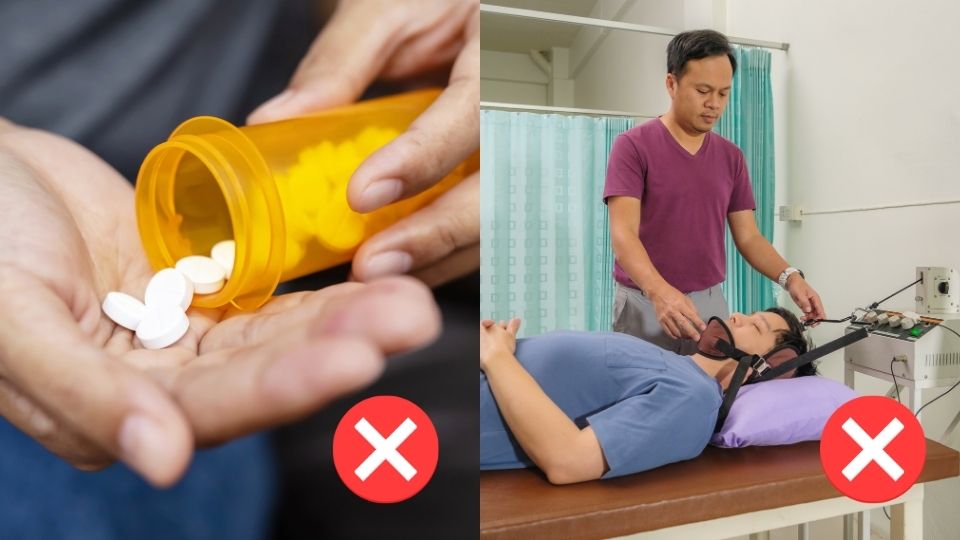
🔹 WHY TREATING EACH SYMPTOM SEPARATELY NEVER FULLY WORKS
Reflux medication, anti-anxiety prescriptions, vestibular exercises, and sleep aids can all partially help — temporarily.
But they all share the same limitation:
They address individual downstream outputs — not the single structural source that's simultaneously generating all of them.
So the cycle continues:
You treat the reflux → stomach settles briefly → neck load unchanged
You manage the palpitations → heart calmer for a week → same compression
You work on balance → dizziness reduces → muscle overload continues
You take something for sleep → rest improves briefly → fatigue returns
You're treating four branches of the same tree.
The trunk remains untouched.
To create lasting change, you need to:
• Release the mechanical overload from the suboccipital muscle group
• Decompress all three neural pathways simultaneously
• Re-engage the deep cervical stabilizers so the load distributes correctly and doesn't immediately rebuild
That's exactly what HealthEase was designed to support.

🔹 AT-HOME CHECK
Ever notice any of these?
• Fatigue that sleep doesn't fully repair — regardless of hours
• Dizziness or lightheadedness when standing up or turning the head
• Heart flutters or palpitations that no cardiac test can explain
• Reflux or lump-in-throat feeling that persists despite medication
• Tension headaches that start at the base of the skull
• Symptoms that tend to cluster together — worse on the same days
• Multiple specialists, multiple "normal" results, still no answers
These are common signs that a single structural overload in the upper cervical spine may be affecting multiple downstream systems simultaneously.
Left unaddressed, this pattern tends to compound:
• Each specialist treats their symptom — none connect the source
• Medications multiply — one for reflux, one for anxiety, one for sleep
• Fatigue deepens as the body continuously compensates
• Confidence erodes — "maybe it really is just stress"
That's why we created a way to address the structural source, safely at home, in just minutes a day.
Meet HealthEase
NeuroCervical™ Core Therapy
A 4-in-1 At-Home Device Designed to Support Upper Cervical Decompression & Multi-System Nervous System Rebalancing
Most neck devices treat one symptom, superficially.
HealthEase is different.
It was designed to target the suboccipital overload zone — the structural source from which balance disruption, cardiac irregularity, digestive dysfunction, and systemic fatigue can all simultaneously originate — using four clinically-informed mechanisms that work together.
Instead of managing four symptoms, HealthEase focuses on the one structural source they share.
Here's what it combines:
Patented 26-Degree Cervical Traction
Counteracts forward head posture at the precise 26-degree angle that directly addresses the mechanical driver of Upper Cross Syndrome.
This geometry simultaneously elongates the anterior cervical muscles pulling the head forward and decompresses the posterior structures where the three neural pathways are being compressed.
EMS (Electro Muscular Stimulation)
Sends electrical pulses into the overloaded suboccipital and cervical muscles, forcing rhythmic contraction and release across the full muscle group.
This breaks the sustained static compression on all three neural pathways simultaneously.
As the muscles release their chronic grip, pressure on the balance sensors, sympathetic ganglia, and vagal pathway drops — across all three systems at once.
Targeted Massage Heads
Work into the posterior cervical muscle chain, releasing the surface and mid-layer tension that maintains postural collapse.
When these muscles release, the head can begin to return over the spine — reducing the mechanical load that's keeping the circuit breaker panel tripped.
Therapeutic Heat
Dilates blood vessels across the entire cervical region, increasing circulation to all compressed neural tissue simultaneously.
Reduces systemic inflammation in all three pathways and creates the biological environment needed for multi-system recovery to begin in parallel — not one system at a time.
This isn't just comfort.
It's a structural approach to releasing the single source responsible for the multi-symptom cascade — resetting the circuit breaker panel, not just one wire at a time.
Just lie back, let the device cradle your neck, choose your settings — and let HealthEase do the work.
No appointments.
No drugs.
No cracking.

How HealthEase Works (Step by Step)
Step 1 – Counteract the Postural Overload with Cervical Traction
The 26-degree traction system directly counteracts the forward head
position that's overloading the suboccipital muscles.
As the head returns toward a neutral position, the mechanical load on the three compressed neural pathways begins to reduce simultaneously.
Step 2 – Release the Multi-System Compression with EMS
Low-frequency EMS pulses force the overloaded suboccipital and cervical muscles
into rhythmic contraction and release.
This is the key mechanism:
as the muscles cycle through release, the sustained compression on the balance sensors, cardiac ganglia, and vagal pathway drops — across all three systems at once.
Step 3 – Restore Postural Balance with Targeted Massage
Floating massage nodes work into the posterior cervical chain, releasing
the surface and mid-layer tension that has been maintaining the postural collapse.
When the posterior chain releases, the head can begin to sit back over the spine —
progressively reducing the mechanical overload at the source.
Step 4 – Accelerate Multi-System Recovery with Therapeutic Heat
Gentle, targeted warmth dilates blood vessels across the full cervical region,
increasing circulation to all three compressed neural pathways simultaneously.
Many users describe a shift from feeling systemically "off" across multiple areas —
to a whole-body sense of calm — as all three pathways begin to decompress together.
10 minutes a day is often enough to begin resetting the circuit breaker.

What People Commonly Notice Over the First Few Weeks
While everyone is different, many users describe a similar progression:
By Day 1:
Neck and shoulders noticeably lighter after the first session.
Many users report breathing more deeply immediately — as the chest and upper cervical muscles release, the diaphragm can expand more fully.
This is a documented effect of Upper Cross Syndrome decompression.
By Week 1:
Afternoon energy levels begin to improve.
Headaches less frequent.
Sleep deepens and nighttime awakenings reduce — a signal that the autonomic nervous system is beginning to rebalance as mechanical pressure on the cervical sympathetic ganglia eases.
By Week 2:
Multiple symptoms begin improving simultaneously — less dizziness, more settled digestion, calmer heart rate.
This is not coincidence.
This is the circuit breaker resetting.
When the single compression source is released, the three dependent systems recover together.
By Week 4 and Beyond:
Full-system compression released enough for the body to function near normally.
Users describe:
"I explained different symptoms to different doctors over years.
Within a month, most of them were gone.
They all had the same source."
Over 31,000 people worldwide now use HealthEase daily as their go-to at-home multi-system cervical decompression routine.

Picture a Day Where Your Body Finally Works Together
Imagine this:
You get up from the couch and the room stays still.
You sit through a meeting without watching your heart rate.
You eat dinner without wondering if tonight will be a reflux night.
You make it to the end of the day and you're tired — the normal kind,
not the bone-deep exhaustion that sleep never fully repairs.
You wake up and think about your day —
not about which symptom might flare up first.
That's what life can start to feel like when the one structural source responsible for all of it is finally addressed — instead of treating four branches while the trunk remains untouched.

What’s the Price of HealthEase?
When you consider:
• The cumulative cost of multiple specialist visits
• Ongoing prescriptions for reflux, anxiety, sleep and pain
• Time lost to fatigue and flare-ups
You'd expect a 4-in-1 clinical-grade cervical decompression device like HealthEase to be expensive.
But for a limited time, you can get HealthEase for up to 53% off the regular price.
That means:
Daily cervical traction, EMS, targeted massage and heat
For less than the cost of one specialist visit.
One device. One-time investment.
Stocks are limited.
👉 Click below to check availability and apply your discount.
Try HealthEase for 365 Days, Completely Risk-Free
We know it can feel exhausting to try something new — especially
when you've already seen multiple specialists, tried multiple treatments,
and come back with the same "normal" results across the board.
That's why HealthEase comes with a 365-day results guarantee.
Use it consistently. Let it:
- Release the suboccipital overload compressing all three neural pathways
- Decompress the balance sensors, cardiac ganglia, and vagal pathway
- Retrain your deep cervical stabilizers so the overload doesn't rebuild
If you don't feel a meaningful change in your energy, balance, heart calm, and digestive comfort…
send it back for a full refund.
No stress. No questions. No risk.
It's essentially a 365-day at-home trial to see what happens when you finally address the structural trunk — instead of continuing to treat four separate branches.
UPDATE: Selling Out Fast Due to Viral Demand
Since HealthEase started gaining traction on social media, we've had a hard time keeping it in stock.
With the limited-time 53% discount, demand is through the roof.
We still have a few units left — but at this pace, we expect them to sell out soon.
👉 Secure your discount and check availability now.
What Are People Saying About HealthEase?

Reviewed in the United States on May 05, 2024
Verified Purchase
I was bounced between cardiology, ENT, and gastro for years. Palpitations, reflux, dizziness — every test came back 'normal.' I honestly thought I was losing my mind. After learning about the vagus nerve and trying HealthEase, things finally clicked. Within the first week the spinning when I stood up started to calm down. By week three, my reflux and chest rushes were way less frequent. I still use it most evenings because it's the only thing that makes my neck and nervous system feel truly quiet.

76 people found this helpful

Reviewed in the United States on May 25, 2024
Verified Purchase
I've got a long history of neck issues and two herniated discs, but the worst part was the vertigo. I'd stand up and feel like the floor tilted. My doctor said it was 'just anxiety.' HealthEase was the first thing that actually addressed the base of my skull. The combination of traction, EMS and heat makes that area feel open and light. I still get the occasional off day, but it's nothing like before. I can work, drive, and play with my kids without constantly worrying the room will start spinning.

53 people found this helpful

Kate Michaels
Reviewed in the United States on May 25, 2024
Verified Purchase
I bought HealthEase for neck pain from working at a desk, but the surprise benefit was my digestion and throat. I used to feel like food was 'stuck' and I was always clearing my throat. A few weeks into using this, that tight, choking feeling almost disappeared. My neck feels longer and looser, and I notice I'm not reaching for antacids like before. It's become part of my night routine — 15 minutes on the couch before bed and my whole upper body feels calmer.

64 people found this helpful